
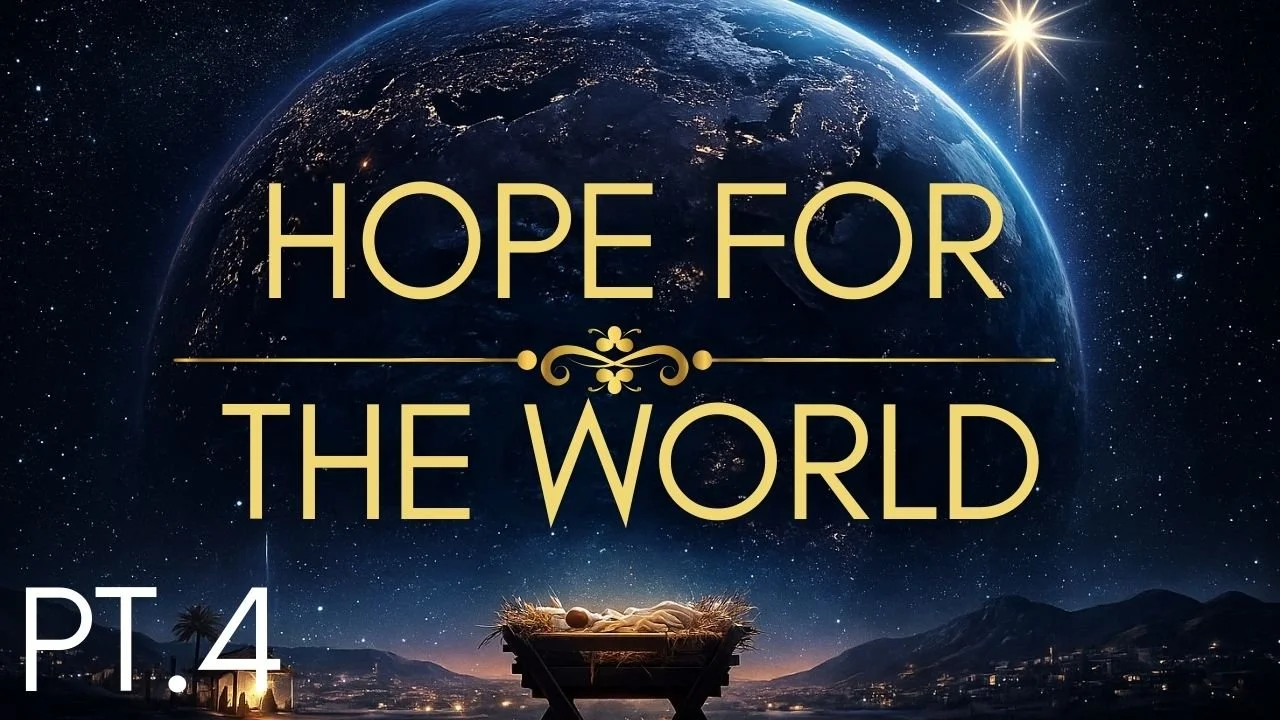
Hope for the World: When Hope Came Near
John 1:10–14
Hope Is Not an Idea—Hope Has a Name
Over the weeks of Advent, we’ve been tracing one central truth: hope is not something we believe in—hope stepped into history as a person. And His name is Jesus.
Hope didn’t begin in Bethlehem. Jesus is eternal. Long before the manger, long before the angels and shepherds, hope was already planned. And when hope finally came near, it didn’t avoid darkness or brokenness—it confronted it head-on. Not on our terms. Not in our timing. And not centered on our comfort.
Christmas Eve brings us to the climax of the story: hope didn’t just speak—hope put on flesh.
1. Hope Came Into a World That Didn’t Want Him
John tells us plainly: “He was in the world… yet the world did not recognize Him.” (John 1:10)
From the very beginning, Jesus—the embodiment of hope—was rejected. No palace. No parade. No room. Just a borrowed stable and a feeding trough. The world barely noticed.
And that rejection didn’t stop at the manger. The same world that had no room for Him at birth would later cry out for His death. The manger isn’t a contradiction to the cross—it’s a preview.
Here’s the shocking beauty of Christmas: God did not wait for humanity to be receptive before He came close. He didn’t wait for understanding, agreement, or moral improvement. Hope came anyway.
Even when the world said, “There is no room,” God said, “I’m coming anyway.”
2. Hope Put on Flesh and Moved Into Our Mess
“The Word became flesh and made His dwelling among us.” (John 1:14)
God’s response to sin wasn’t distance—it was incarnation.
He didn’t shout instructions from heaven. He didn’t send a rulebook and hope we figured it out. He moved in. Into weakness. Into hunger, exhaustion, pain, temptation, and suffering.
Christmas reveals a God who would rather be close than comfortable. The Author of life stepped into death—not because He had to, but because He chose to.
Like medics setting up a field hospital in a war zone, Jesus entered the chaos. He came close enough to touch wounds, to carry pain, and to suffer with us. That’s Christmas. God setting up camp in the middle of our brokenness.
3. Hope Entered Our Weakness to Restore Us
“Yet to all who did receive Him… He gave the right to become children of God.” (John 1:12)
This verse is gentle—but demanding. Not everyone becomes a child of God. Only those who receive Him.
Receiving Jesus isn’t agreement—it’s surrender. It’s allowing Him not just to save your life, but to lead it. Like Joseph, whose obedience cost him comfort, reputation, and control, receiving Jesus always costs something.
But it also restores everything.
Jesus didn’t stand at a distance and tell us how to escape sin. He entered the darkness with us. He carried what we couldn’t. He didn’t just show us the way—He became the way.
Christmas Eve Invitation: Hope Is Still Coming Close
We live in an anxious, restless world—more connected than ever, yet starving for peace. Christmas declares something radical: peace isn’t something you find. Peace is Someone you receive.
Hope didn’t stay distant. Hope came near. Near enough to be born. Near enough to suffer. Near enough to die. Near enough to rise again.
And tonight, hope is still coming close.
Because the peace you’re looking for
is already looking for you.
