
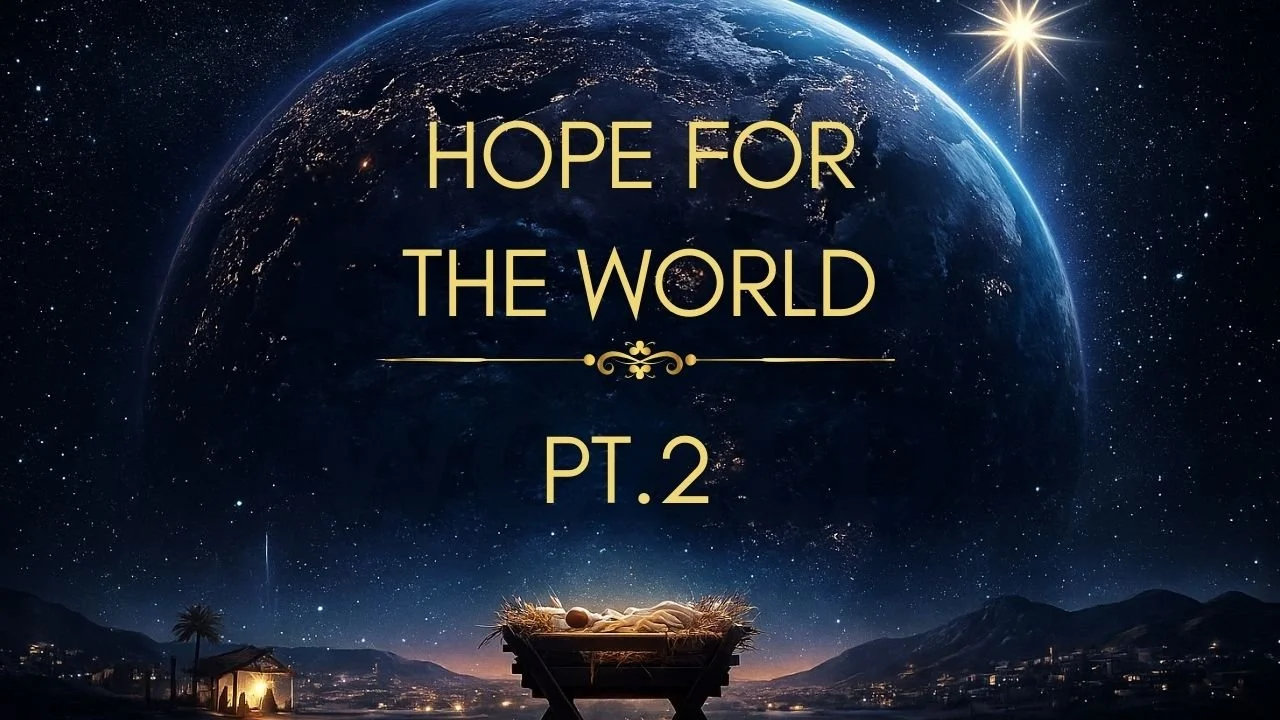
Hope for the World Pt. 2: Hope That Confronts the Darkness
When Hope Came Near — It Didn’t Avoid the Dark
Last week, Advent began by going back to the beginning. We discovered that hope didn’t start in Bethlehem — Bethlehem is where eternal hope stepped into time. Jesus’ arrival wasn’t God reacting to sin; it was the unveiling of an eternal plan. Redemption was the blueprint before the world began.
That truth shapes our Advent theme: “Hope Came Near — Now Hope Goes Out.”
When Jesus came near, God didn’t shout instructions from a distance — He stepped into our world Himself. Hope has a name, and His name is Jesus. And because Hope came near, hope now moves through His people.
But Week 2 of Advent forces us to wrestle with a harder truth: when Hope came near, He didn’t avoid the darkness — He confronted it.
Hope Shines in the Darkness
John writes:
“In him was life, and that life was the light of all mankind. The light shines in the darkness…” (John 1:4–5)
Jesus didn’t wait for the world to get better before entering it. He stepped directly into the night as the Light of the world. Real hope doesn’t run from darkness — it reveals it, heals it, and overturns it.
Luke’s Gospel tells us that the angelic announcement of Jesus’ birth came at night, to shepherds watching their flocks. Cold fields. Forgotten people. Perfect darkness. And yet, this is exactly where God chose to shine His brightest light.
Throughout Scripture, God consistently works this way:
Light enters darkness at creation
Deliverance comes in the night at Passover
Isaiah proclaims light dawning on people walking in deep darkness
If God was sovereign over the timing of Christ’s announcement, He is sovereign over yours. You are not early. You are not late. You are here on time — God’s time.
Hope Confronts the Darkness
Matthew 2 reveals the part of Christmas we often skip. The birth of Jesus didn’t happen in peaceful isolation — it triggered resistance. Herod panicked. Violence erupted. Families fled. Darkness fought back.
Christmas is not merely a cozy scene — it is confrontation. Light threatens darkness simply by showing up.
This is where honest questions arise: If God is love, why is there suffering?
Scripture never minimizes suffering. It shows us something deeper: suffering is real, but it is not proof of God’s absence — it is the very reason God came. God did not create evil; human choices did. But instead of staying distant, God stepped directly into the brokenness.
Jesus was born into danger on purpose — not to avoid suffering, but to confront it and ultimately defeat it.
Hope Overcomes the Darkness
John finishes the thought with a declaration, not a wish:
“…and the darkness has not overcome it.” (John 1:5)
Darkness can resist, but it cannot win. John speaks in the past tense because the outcome was settled the moment Hope stepped into the world. Darkness can rage, but it cannot rewrite God’s story.
Christmas declares victory, not vulnerability. Herod ruled with fear and violence — and died. Jesus came without power in the world’s eyes — and conquered death itself.
The Light didn’t flicker. The Light prevailed.
Living as People of Light
We live in an anxious world, overwhelmed by noise, comparison, and constant pressure. But Advent reminds us that peace is not found by escaping darkness — it’s found in the God who entered it.
Because Hope came near, hope now goes out — through us. Into anxious hearts. Into broken homes. Into dark places still waiting for light.
You are not abandoned. You are not overlooked. You are held. And the same Light that shone in Bethlehem is shining in you now.
This is Advent. This is Jesus. This is our hope.
